Critically discuss how the National Quantum Mission aims to position India globally. Why is developing specialized human resource capacity in quantum technologies a major bottleneck?
The National Quantum Mission (NQM) is India’s bid to move from technology user to quantum technology producer. With ₹6,003.65 crore for 2023-24 to 2030-31, it seeks to strengthen India’s role in computing, communication, sensing and materials, and place it among the countries shaping the next digital order.
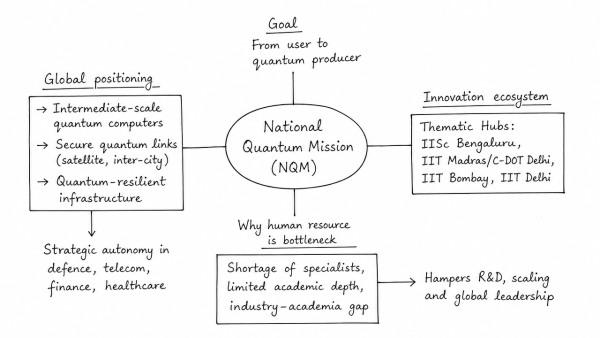
- Global positioning: By targeting intermediate-scale quantum computers, satellite and inter-city secure quantum links, and indigenous quantum-resilient infrastructure, NQM can build strategic autonomy in defence, telecom, finance and healthcare.
- Innovation ecosystem: Thematic Hubs at IISc Bengaluru, IIT Madras/C-DOT Delhi, IIT Bombay and IIT Delhi aim to connect academia, industry and start-ups, improving patents, prototypes and commercialization.
- Critical limits: India is still behind global leaders in scale, funding depth and industrial ecosystem, so the mission’s global impact will depend on sustained execution rather than announcement value.
Human-resource development is the main bottleneck because quantum technologies need a rare mix of physics, materials science, electronics, algorithms and engineering, while India has too few trained researchers, limited faculty, weak specialised courses and a small talent pipeline to support research, manufacturing and start-ups.
Originally written on
August 19, 2026
and last modified on
September 25, 2026.